
The Ultimate Guide to Product Strategy

How to craft your product strategy
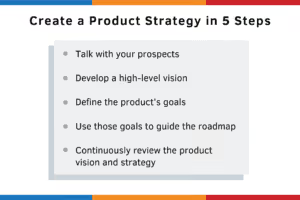
Product strategies aren’t easy to create… if they were, every entrepreneur would be a smashing success, and all startups would turn into unicorns. But following a simple playbook ensures you haven’t forgotten anything.Here are five steps to a winning product strategy:
Factor in the rest of the field
Just like a product manager shouldn’t devise an entire product strategy all by themselves, a product strategy can’t ignore what else is out there. Rare is the case where a product doesn’t face direct competitors or viable alternatives for the services and functions it provides.Conducting a competitive analysis takes a disciplined approach to evaluating the other players vying for potential customers. This exercise should cast a wide net in terms of what solutions prospects are using or considering.Each alternative’s attributes must be assessed, along with which features and capabilities resonate with the target market. Not every checkbox on the feature matrix matters the same to actual buyers and users, as organizations want to avoid becoming feature factories in their quest to “catch up.”

Pricing strategies must also take competitors into account. The product strategy may entail a premium price point or undercutting the competition, but it’s hard to come up with a price tag without knowing what the rest of the market charges.Additionally, product managers shouldn’t be fooled or talked out of playing a role in the pricing strategy. Despite what sales or business development might say, product management has the best understanding of a product’s COGS (cost of goods sold), and its real value to different customers.Instead, product management should play an active part in the product’s pricing strategy, collaborating with other parts of the business to devise a model that drives growth and hits the company’s revenue and profitability goals.
Read the Power of SaaS Pricing Experiments ➜
What's the product leader’s role in product strategy?
From a product’s conception until its final sunset, product management’s role must adapt to the different lifecycle stages. Strategy never goes away, but it does have two distinct phases.
Product management throughout the product lifecycle
There is the initial strategy development, which begins with ideation. The strategy goes through rapid evolutions as research rolls in, MVPs are designed and built, feedback is collected, and the product morphs and changes while trying to find product-market fit.
Download the Product-Market Fit Book ➜
Product managers spend far more of their time developing and refining the strategy during this stage than at any other time. There is just so much learning occurring and unknown variables to define.Once the product gets traction, product managers take on a different set of responsibilities. Attention shifts to growth and retention, usually followed by managing a decline or reinvention. Here the product strategy itself shouldn’t see as many significant shifts, although there’s never a time when the topic isn’t part of a product manager’s portfolio.
Staffing up
These lifecycle stages also influence the makeup of the product team itself. Different phases require varying skills, not to mention the volume of work to be done. With this in mind, product management must take a strategic approach to staffing.Hiring product managers isn’t as straightforward as some other disciplines. There’s no ideal resume or degree for product management, and the role requires a unique combination of soft skills, creativity, and technical acumen.Because these demands differ throughout the product lifecycle, product managers must carefully consider when is the right time to scale their team. The ideal team size is also highly dependent on the complexity of the products, the number of products in the overall portfolio, and which areas deserve more dedicated attention.
Download From Product Manager to Product Leader ➜
Collaborating with other teams
Despite building out a product team, product strategy meetings must involve other parts of the organization. No matter how many great ideas and talented individuals comprise the product management ranks, input from other departments is crucial.Keeping these product strategy meetings from going off the rails is yet another challenge product managers face. Everyone brings their biases, pet projects, favorite shiny objects, and anecdotal evidence to the table.Better product strategy meetings manage to incorporate these varied insights without turning into a free-for-all by keeping everyone on topic, putting all other side issues in your Parked Items, and setting clear rules of engagement and goals for these sessions. Checking egos at the door, unemotionally defending firmly held beliefs, and communicating the results are other secrets to success.

How to tie product metrics to a product strategy?
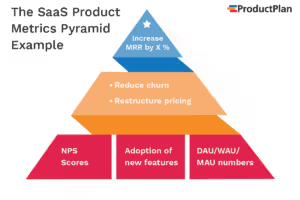
While a viable product strategy must encompass more than a series of measurable targets, metrics play a vital role in defining and executing the product strategy.Product managers don’t have to reinvent the wheel when it comes to defining product metrics. There’s an existing set of well-understood and valuable metrics at their disposal, assuming the instrumentation and reporting are in place. The fun/tricky part is deciding which ones to concentrate on.The product’s maturity will also dictate which metrics are most relevant to that phase of the product strategy. Once a product is getting used and the analytics are rolling in, product managers can use metrics to adjust and enhance the product strategy. The data provides a valuable feedback loop and can quantify the anecdotal observations.
How to align the roadmap under the product strategy?
How to stay accountable with your product strategy
A product strategy’s viability and performance reflect directly back on product management and its credibility. If it seems out-of-step with reality or isn’t delivering results, the blame and finger-pointing will always land on product managers.With this in mind, product managers should be fully confident in their product strategy. If there’s anything shaky in its foundation, they have to immediately investigate and mitigate any shortcomings, errors, or oversights.
Inherited product strategies
Not everyone is there from Day One, so some product teams find themselves managing products where someone else created the initial strategy. However, this doesn’t mean it should be scrapped, and everyone should start from scratch.The team should unpack for themselves, ensuring any misunderstandings aren’t personal. The current strategy’s meaning to stakeholders should be determined, as historical drivers and beliefs fuel it.Most importantly, revisit the assumptions used to craft the existing strategy, challenging them when appropriate. Markets evolve, new research uncovers additional things, and the current strategy’s underlying basis may no longer be valid.
Avoid stale strategies
Product strategies should be revisited regularly (monthly or quarterly is a good cadence). Start with the assumptions and then bounce alternatives and new things against them. If the strategy stands up to this scrutiny, it’s still in good shape. If not, it’s probably time for a refresh.Frequent strategy revisions and mid-course, minor corrections are more accessible than making a full-scale change after not revisiting it for a while. Persistent reevaluation also protects product management’s trust and reputation as the strategy isn’t drastically changing all the time.It’s also prudent to revisit user personas. As usage grows, it may turn out the people using the product may not exactly match the initial crop of personas used in earlier strategy development. Plus, there may be entirely new markets finding value in the product that wasn’t part of the original plan.
Ready to build with confidence?

.svg)

.svg)