
The Ultimate Guide to Product Management
The Ultimate Guide to Product Management
The question, “What is product management?” comes up pretty often, even from experienced business people. One reason is that product management encompasses a wide-ranging area of responsibilities. Indeed, the role itself means very different things in different organizations. Ultimately, product management is the practice of strategically driving the development, market launch, and continual support and improvement of a company’s products. Of course, that is an abstract explanation of the role. So what is product management? What does the job entail?
What is product management?
More than ever, product managers are facing increased complexity in their role, spanning strategic and tactical duties. Most product managers or product owners are increasingly facing new hybrid requirements in their daily work that span research, design, and even development, based on findings from the 2026 State of Product Management report from Product Led Alliance. Core to the role of an effective product manager are the daily focuses of:
- Conducting Research: Researching to gain expertise about the company’s market, user personas, and competitors.
- Developing Strategy: Shaping the industry knowledge they’ve learned into a high-level strategic plan for their product—including goals and objectives, a broad-strokes overview of the product itself, and maybe a rough timeline.
- Communicating Plans: Developing a working strategic plan using a product roadmap and presenting it to key stakeholders across their organization: executives, investors, development teams, etc. Ongoing communication across their cross-functional teams throughout the development process and beyond.
- Coordinating Development: Assuming they have received a green light to move forward with their product’s strategic plan, coordinate with the relevant teams—product marketing, development, etc.—to begin executing the plan.
- Acting on Feedback and Data Analysis: After building, testing, and introducing the product to the marketplace, learning via data analysis and soliciting direct feedback from users, what works, what doesn’t, and what to add. Working with the relevant teams to incorporate this feedback into future product iterations.
- Driving Adoption & Revenue: Product leaders play a critical role in driving revenue and growth for an organization, and making data-driven choices about what to build in the AI era is the most challenging part of the job today. If a new feature isn't being adopted, a product manager will dig in with customers and field teams to evaluate what else is needed to make the product a success as measured by driving revenue.
Click here to explore how product leaders use roadmaps as a strategic communication tool throughout this process to keep stakeholders informed and aligned.
What are the top responsibilities of a product manager?
Ultimately, product management is a strategic function. Tasking product managers with determining a product’s overall reason for being—the product’s “Why?”They’re also responsible for communicating product objectives and plans for the rest of the company. They must ensure everyone is working toward a shared organizational goal. Product management encompasses a broad set of ongoing strategic responsibilities. They shouldn’t be responsible for the ground-level details of the development process. Innovative organizations separate this function and assign tactical elements to project managers, such as scheduling and managing workloads. This distinct division leaves the product manager free to focus on the higher-level strategy. Product managers develop strategies in these 5 steps:
- Talk to customers and prospects
- Survey the competitive and market landscape
- Develop and test a vision, including gathering cross-functional feedback
- Define commercial goals and KPIs
- Scope requirements
- Add the product to the roadmap
- Plan for deployment, including core messaging and positioning in partnership with GTM teams
- Deploy and drive adoption
- Measure performance and product acceptance
- Optimize and iterate
How do product roles vary?
Product management roles are rapidly changing in the AI building era. In larger organizations, there are also specializations that team members can pursue related to product research, product design, product data analysis, product operations, product strategy, and even product marketing.
A product manager will usually own one or more products or a horizontal function across multiple products, such as “user experience” or “e-commerce.” Associate product managers and junior product managers are typically new to the domain and have more limited responsibilities. A senior product manager will have a little more seasoning and a broader scope of their role.
Technical product managers are another critical variation of the role. These individuals are often transitioning from a role in the engineering or IT teams and tasked with managing aspects of one or more products requiring a deeper understanding of technical issues, such as infrastructure and APIs.
How do agile product managers differ?
In an Agile organization, product owners also may be part of the puzzle. While there’s some debate, product owners are often considered part of product management. However, they are distinct from product managers. A product owner is embedded in one or more scrum teams, but their focus is mainly tactical, helping ensure the strategy laid out by product managers is appropriately executed. As one moves up through the ranks, more senior product management roles have more significant distinctions. For example, a product line manager will own multiple products that are typically related to each other, sometimes overseeing individual contributor product managers that manage a single product or sub-component.
What is a typical career trajectory for product managers?
The road to an executive product role begins with Director and Senior Director roles. Depending on a company’s size, this may be a loftier title for a “lone wolf” product management professional. But, on the other hand, it may indicate an even broader portfolio of products and the corresponding direct reports to support that. Vice President and Senior Vice President of Product roles have broader responsibilities for more people, including business analysts, UX, product marketing, or other related functions. The apex of a product management career is Chief Product Officer. Although not as common, this increasingly seen role elevates product management to the C-suite. It gives the product the same political weight as Revenue, Engineering, Finance, or Marketing which often indicates an organization is committed to product-led growth. A CPO is typically supported by a larger team and provides directional guidance and coaching rather than diving into the nitty-gritty details of particular products.
What are product roadmaps?
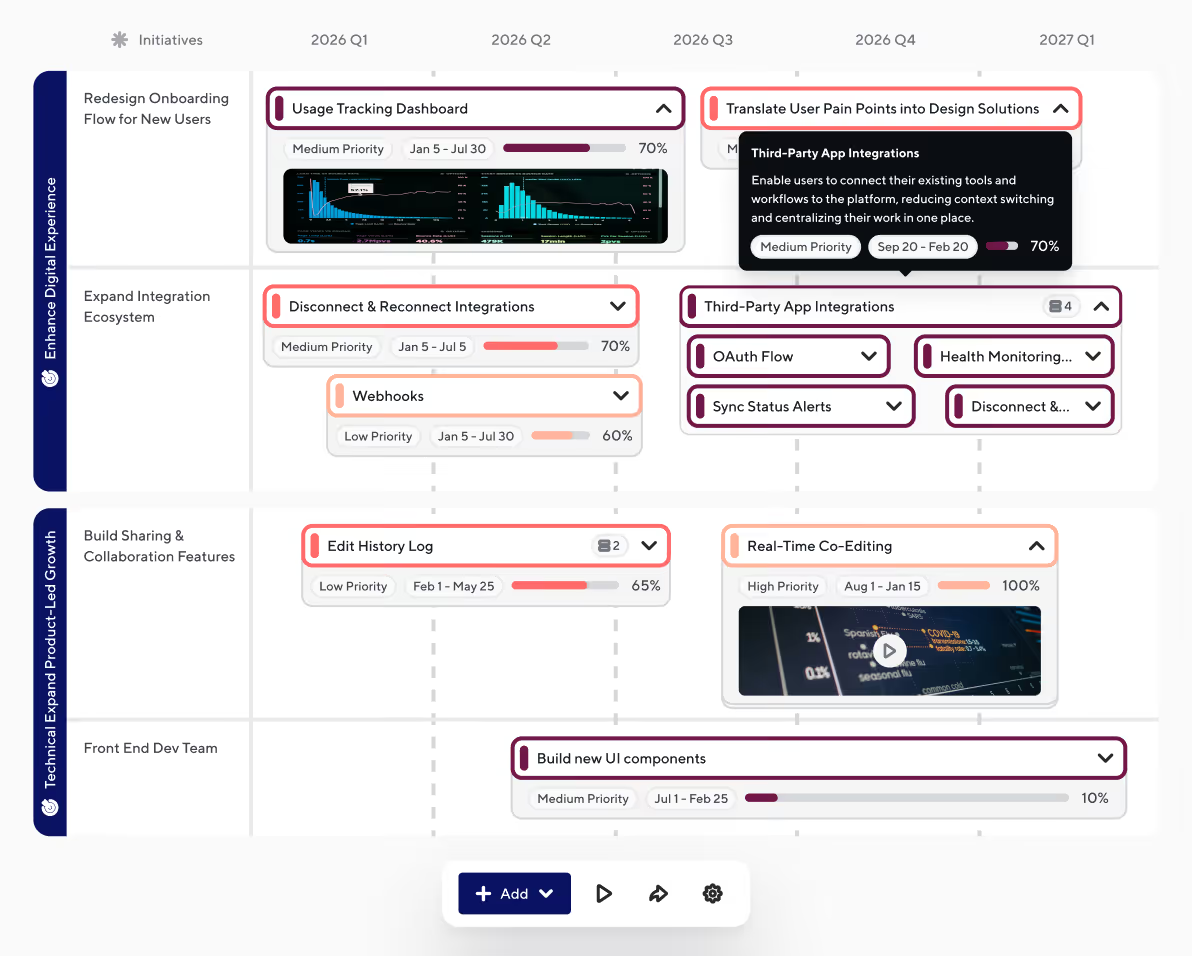
Product roadmaps reflect the culmination of countless hours of research, negotiations, strategizing, and consensus-building. In the era of AI building, decision certainty is the most critical factor for successful product leaders, and roadmaps are evolving to become communication tools that keep everyone informed and aligned about what's being built, and why. Explore ProductPlan's Product Intelligence Solution.
Product roadmaps set the agenda and set expectations for the entire organization. They set a course for the future and provide a point of reference to inspire the whole organization. They turn the mission and vision into a concrete plan for making bold ideas a reality.
What is product prioritization?
Product managers face endless pressures, loud voices, and lots of choices and tradeoffs when thinking about what to build. Having an effective prioritization methodology is critical to ensuring that the right things are being built, based on data and evidence versus "squeaky wheels" or the loudest voice in the room. Explore ProductPlan's Product Prioritization Solutions.
There are many proven and effective prioritization frameworks teams
Download Feature-less Roadmaps: Unlock Your Product's Strategic Potential ➜
What are important product management tools?
Product managers have more options than ever when it comes to tools. They cover a wide range of tasks and areas that product managers are responsible for.But a product manager’s job involves a lot more than gather product insight, tracking the backlog, and reviewing the product roadmap. Whether you’re a new product manager or a seasoned PM just wanting to make sure you’re not missing a key component of your role because you’re lacking the proper tool—the following is a list of product management tools to help you excel in your role.These include solutions for tracking user behavior, including heat mapping and session replays. Plus, there are surveying tools for gathering feedback. There are also a host of new options for collaboration. It encompasses asynchronous messaging, voice chats, file sharing, and document editing.For demos, presentations, and onboarding, product managers can turn to web conferencing tools that support screen sharing and recording. These can also be co-opted for low-budget usability testing, as product managers can “ride-along” while users complete tasks using their products. Quickly visualize concepts and workflows with wireframe tools and flowcharts.Project management tools have also made a massive impact on how product managers keep track of things. There’s no excuse to be managing your life and projects in a spreadsheet.And, of course, there’s a pretty good tool for creating roadmaps we’re quite fond of. By relying on some of these solutions, product managers can increase their efficiency, become better collaborators, and make sure nothing falls through the cracks. Roadmapping software is a must-have item on any list of product management tools. Using any non-native roadmap application to draft and maintain your product roadmap (such as spreadsheets or slide decks) will create far more work, be far less flexible and easy to share, and more prone to version-control issues that can slow your product’s progress. This is exactly why we built ProductPlan. Explore ProductPlan's User Research Solution.
Download the Product Manager's Toolkit ➜
What is the best way to secure a product tool budget?
Product managers shouldn’t be shy about asking for a tools budget; their time is just as valuable as other contributors. Requesting budgets for a tool is still a relatively rare occurrence for product teams, who traditionally haven’t had any dedicated budget and rarely ask for anything financial other than approving travel expenses or a new laptop. So, how do you successfully broach this subject with the executives holding the purse strings?1. Make assumptions2. Strength in numbers3. Acknowledge the alternatives4. Try the free-trial5. Overcome the uncomfortable ask
Download Get Buy-In on Your Product Stack➜
What are the differences between B2B vs. B2C product management?
One common belief in product management is that there is a vast difference between working on B2B and B2C products. While there are certainly some distinct aspects between those two worlds, they have plenty in common.For B2C, your users are generally also your buyers, and you’re serving a single persona. For B2B, the person controlling the budget is often unrelated to the person who regularly uses the product. After identifying each persona, product managers can tailor the product and the pitch for each one of them.Both situations require multiple value propositions. Even single consumers are looking for numerous reasons to buy and use a product. Therefore, messaging should always speak to practical, emotional, and financial justifications for taking the plunge.It impacts the sales process, as B2B sales take a lot more convincing and win over many hearts and minds for a single transaction. And the cost of acquisition will be higher, and the growth rate slower for a B2B product.But with proper expectations, there’s no reason the same skills and experiences can’t be transposed from one market to another. Product managers shouldn’t feel pigeonholed into only working in one market or the other. It just might take a little more convincing during the hiring process to shake them out of their false preconceptions. See How ProductPlan Helps Industries Like SaaS.
How do teams optimize product operations?
Product managers have an often overwhelming amount of obligations. Time is a precious commodity. They must be efficient and organized to conduct the necessary conversations and meetings while still having enough bandwidth actually to get some work done.
What are effective ways to drive the process for product decisions?
Making decisions—and getting internal consensus on those decisions—can be a huge time suck. To get through them all promptly, product managers must find a scalable way to get to an agreement quickly. Clearly defined roles and a consistent process let the parties involved focus on the subject at hand.A divide-and-conquer approach is another tactic for getting more done in less time. Recognizing the core strengths of everyone available, splitting up tasks, and delegating things lets product managers focus on what they do best while not neglecting anything else that’s important.Product managers can also borrow some useful skills from their project management counterparts. This includes defining explicit scopes and sticking to them, cutting down on diversions and ratholes. It’s additionally helpful to create clear action plans and communicate them to relevant colleagues to be sure everyone knows what they’re responsible for and understand the expectations.Even how product managers schedule their day can lead to increased output and higher-quality working sessions. By minimizing context switching, product managers can cluster similar tasks together to maintain focus and limit distractions.This includes making time for strategic thinking. It’s tough to take a deep dive into a particular subject when there are constant interruptions. Product managers must carve out time for this critical task and create an environment where they can concentrate.
How do teams run effective product meetings?
Meetings are unavoidable for product managers. They have the potential to offer tons of value. But when mismanaged, they can turn unproductive and suck up time they don’t have to spare.Among our meeting tips for product managers, the focus is on efficiency. Whether it’s limiting attendance or defining a narrow scope, the goal is to have a purpose, stick to the plan and get it over with as fast as possible.Follow-through is also essential. Product managers should take notes, circulate key information, and clarify any action items before everyone leaves. Of course, the best advice might be skipping the meeting altogether if it proves to be more distracting than beneficial.
How do teams run effective customer meetings?
While internal meetings may seem like a chore, meeting with customers is one of the best parts of the job. It’s an opportunity to capture an unfiltered influx of feedback, ideas, and inspiration that can help product managers power through the less-than-awesome aspects of the situation. Meeting directly with customers is always preferable to relying on coworkers in sales or support to funnel information back to the product team. Of course, this may not always be possible, but product managers should seize these opportunities when they arise. While sales and support might bring back valuable tidbits, they’re conducting conversations with customers through the lens of their particular jobs. The sales team is trying to gin up more business; support aims to solve the customer’s problems and move on quickly. Explore ProductPlan's AI Customer Insights.
Read the Customer Interview Toolbox ➜
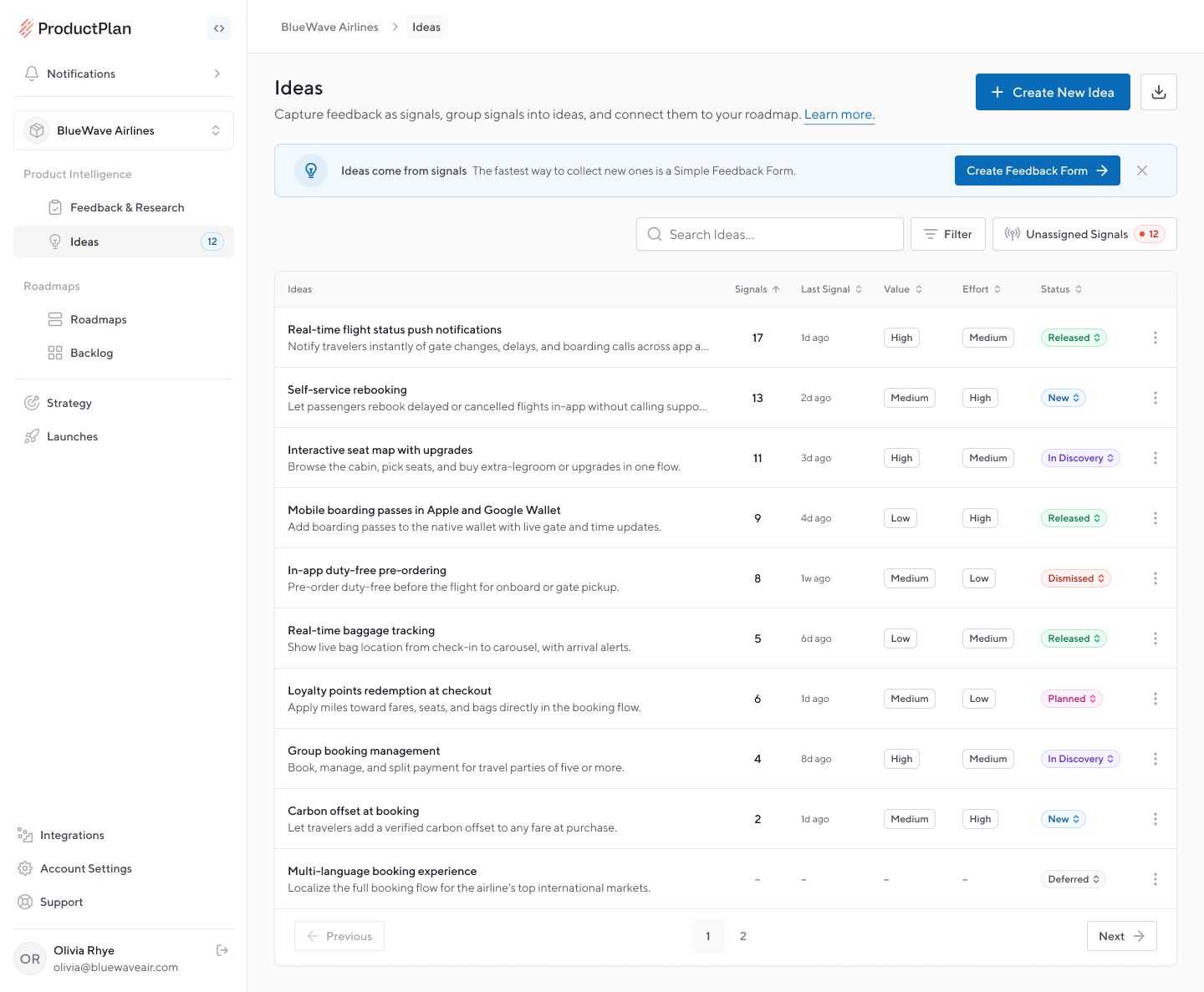
As a product manager, the only goal is to understand the customer better so the product experience can be improved and enhanced. These conversations can yield invaluable context for using the product and where they’re encountering challenges. Product managers should also take some worthwhile detours to explore other ancillary opportunities where the product could potentially be even more valuable or helpful to users. Product management needs an established process for handling this feedback. First, ideas worth pursuing must be captured and tracked. Whether they’re eventually slotted into a release or discarded, customers who provided suggestions should be informed either way. This follow-up will encourage future feedback, and it shows customers their input is appreciated. And while it may not always be pleasant, it’s also great to have conversations with ex-customers. Using “exit interviews” to collect churn feedback can shine a spotlight on key product flaws or shortcomings that might cause other users to call it quits. It may also uncover disconnects in product-market fit or pricing that motivate some customers to abandon the product. Explore ProductPlan's Idea Management Solutions.
What are effective agile product management operations methodologies?
Agile has been around for a while in the product development world. However, Agile Transformation is a newer concept that brings the dynamic, nimble, responsive qualities of Agile to the entire organization.One permutation of this approach is the concept of product squads. Pioneered by Spotify, they are autonomous teams with a group of developers and one product owner. Assigned to a particular functional area of the product, they’re able to attack the challenge freely. As a result, they can rapidly deliver value to the market while building in-house expertise on the subject.
Product squads may or may not make sense for a particular company or product. But they’re a great example of how product teams can reconfigure themselves to respond to opportunities more dynamically. Freed up from bureaucratic oversight, ad hoc or permanent groups can take ownership and drive rapid innovation.
What are typical product launch responsibilities?
After the product ships, product managers don’t get to kick up their heels and relax. There’s still plenty of work to be done.
Quickly following a launch, product managers should lead a product retrospective session. This post-mortem meeting looks back on how the release went. It ensures lessons are captured and brought forward to improve things the next time around. These aren’t just sessions for finger-pointing and blaming others for what went wrong. Instead, it’s an opportunity to offer praise, recognize good work, and collaboratively identify best practices and the areas needing improvement.
Download The Product Strategy Playbook ➜
While everyone’s always excited about version 1.0, a product’s lifespan will include many ups and downs along the way. Likewise, the role of product management also evolves as a product matures and travels through the various phases of its lifecycle.
Before launch, subject matter expertise was the priority for product managers. So they’re trying to learn as much as they can from as many sources as possible. In addition, they’re prioritizing features for the MVP to make sure they’re delivering something with real benefits to the market. After the initial launch, the focus quickly shifts to growth. Product management worries about scale while adding functionality that continues to propel growth. Once all those new users are onboard, the emphasis transitions to retention. It’s all about what’s required to keep customers happy and minimize churn. Most products inevitably begin to decline in usage, which presents new challenges. Product managers must consider how the product can be repurposed, extended, or pivoted toward new verticals. This maximizes the company’s value for an asset they’ve invested time, effort, and dollars into over the years.
Sadly, sometimes it’s time to say a final goodbye to a product. Product managers don’t get to skip out on the tasks rela to the end-of-life process, either. They must take the lead, bringing the same consideration they spent on the product’s birth and subsequent iterations. A proper shutdown requires extreme attention to detail. Product managers must map out all possible ramifications that may arise from pulling the plug. From contractual and financial obligations to data portability and migration assistance — there’s plenty to juggle. Most important of all is how the event is communicated. Customers must be handled carefully (particularly if you want to retain their business with other products). Stakeholders, customer service, strategic partners, and sales all require education, talking points, and escalation plans.
In conclusion, the product management role has changed rapidly over the last several years. Maintaining a growth mindset, an extreme focus on customer value and success, and driving AI innovation will define the success of product leaders in the future.
Related templates: Product Roadmap Template, Product Development Roadmap Template, 25+ Product Roadmap Templates, Product Launch Plan Template, Software Roadmap Template, Program Management Roadmap Template, Marketing Strategy Template, Multiple Product Roadmap Template, Theme-Based Product Roadmap Template, Engineering Roadmap Template, Technology Roadmap Template, Business Roadmap Template, Digital Marketing Roadmap Template, HR Roadmap Template, IT Service Management Roadmap Template, Customer-Facing Product Roadmap Template, Mobile Marketing Roadmap Template, Agile Roadmap Template, Executive-Facing Portfolio Roadmap Template, DevOps Roadmap Template, UX/UI Roadmap Template, Release Plan Template, Content Calendar Template, Marketing Plan Template.
Ready to build with confidence?


.svg)